
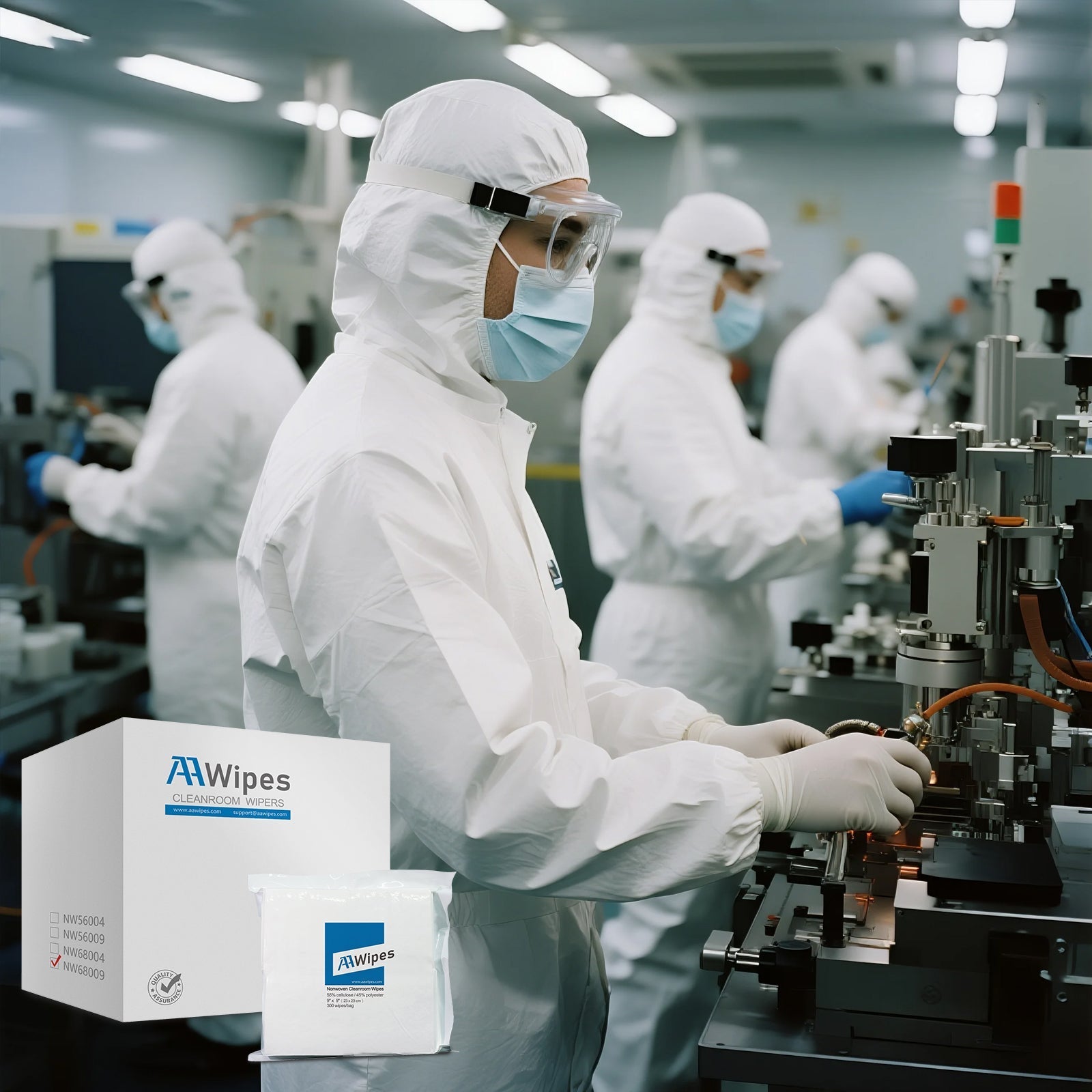
Introduction: The Cost of a Wrong Wiper Choice
In highly controlled environments—such as those dealing with semiconductors, optical lenses, or pharmaceutical compounds—the wrong choice of cleanroom wiper can be disastrous, leading to costly product failure and batch contamination. High-level cleaning often comes down to a choice between two premium materials: Polyester and Microfiber.
While both are excellent performers in ISO Class 5 (Class 100) or better environments, their inherent structural differences mean they excel in entirely different cleaning tasks. This guide provides a professional, scientific comparison to help your procurement and quality teams make the optimal, yield-focused decision. For cleanroom wipes wholesale buyers and cleanroom wipes bulk purchasers, understanding this distinction is key to minimizing long-term operational costs.
1. The Ultra-Clean Choice: Polyester Cleanroom Wipes
Polyester wipers (typically knit or sealed-edge) are the benchmark for ultra-low contamination control.
1.1 Key Technical Advantages
-
Ultra-Low Non-Volatile Residue (NVR): Polyester is exceptionally inert. After high-purity washing (laundered in DI water), it releases minimal extractable contaminants or ionic content, making it crucial when solvents are used.
-
High Strength & Durability: Its strong fiber structure resists snagging and degradation, even when scrubbing rough or abrasive surfaces, which is key in equipment maintenance.
-
Minimal Particle Shedding: Laser-sealed or knife-cut and laundered polyester exhibits extremely low particle and fiber release.
Polyester is often the material of choice requested by organizations sourcing polyester wipes bulk supplier services due to its consistent cleanliness profile.
1.2 Optimal Applications
Polyester is the go-to choice when chemical cleanliness is the priority:
-
Semiconductor Manufacturing: Critical wipe-downs where any residual chemical could compromise processes.
-
Optical & Lens Cleaning: Used with IPA or other solvents to remove oils and residues without redeposition.
-
Equipment Wipe-Down: General cleaning of critical processing equipment.
2. The High-Absorption Choice: Microfiber Cleanroom Wipers
Microfiber wipers are defined by their unique, wedge-shaped fibers, which are typically composed of polyester and polyamide. This bifurcated structure gives them superior mechanical cleaning power. This material is essential for cleanroom wipes for industrial use where heavy oils or fluids are present.
2.1 Key Technical Advantages
-
Superior Contaminant Trapping: The split microfiber structure creates millions of microscopic edges that mechanically trap and hold particles, oil, and bacteria more effectively than smooth polyester.
-
Exceptional Absorption: Due to the increased surface area, microfiber is a champion at absorbing liquids, making it ideal for spill cleanup and handling large amounts of fluid.
-
Non-Abrasive Cleaning: Despite its scrubbing power, microfiber is highly effective for cleaning delicate, high-gloss surfaces (like flat panel displays) where scratching must be avoided.
2.2 Optimal Applications
Microfiber is best when physical removal and liquid handling are the priority:
-
Display Manufacturing (LCD/OLED): Removing fingerprints, smudges, and particulate from sensitive screen surfaces.
-
High-Volume Spill Cleanup: Absorbing large quantities of water or low-viscosity solutions.
-
Viscous Residue Removal: Effectively lifting difficult-to-remove gels, pastes, or sticky residues in compounding pharmacies or R&D labs.
| Specification | Polyester (Knit/Sealed Edge) | Microfiber (Knit/Sealed Edge) | Priority Application |
| NVR & Ionic Content | Extremely Low | Low to Moderate | High-purity solvent cleaning |
| Particle Shedding | Lowest | Low (Minimal fiber release) | Critical component handling |
| Mechanical Scrubbing | Good (High durability) | Excellent (Traps particles) | Cleaning sticky residues/oils |
| Liquid Absorption | Good (Relies on capillary action) | Excellent (High volume absorption) | Spill control/High liquid use |
| Material Cost | Moderate to High | High | Value depends on application yield |
Conclusion and Your Next Step
The selection is not about which wiper is "better," but which one is optimal for your specific process risk and cleaning challenge.
-
Choose Polyester: If your process requires ultra-low extractables, involves aggressive solvents, and focuses on avoiding chemical residue (e.g., semiconductor fabrication).
-
Choose Microfiber: If your process involves high levels of particulate, viscous contaminants, or requires maximum liquid absorption and mechanical cleaning power (e.g., display cleaning or general spill control).
As a reliable cleanroom consumables supplier USA, we provide the exact specifications you need for both knitted polyester and microfiber options. If you are a cleanroom wipes distributor or an industrial buyer looking for nonwoven cleanroom wipes wholesale or bulk pricing on knitted sealed-edge wipes, our US-based inventory and quality control are ready to support your supply chain needs.
Would you like to request a cleanroom wipes bulk quote or samples of specific Polyester or Microfiber grades for validation?